



If you are pregnant or a new mother who is struggling with depression or anxiety, you can call or text the National Maternal Mental Health Hotline, 24/7: 833-TLC-MAMA (833-852-6262). Postpartum Support International can help connect you with a local mental health provider at 800-944-4773 or psidirectory.com.
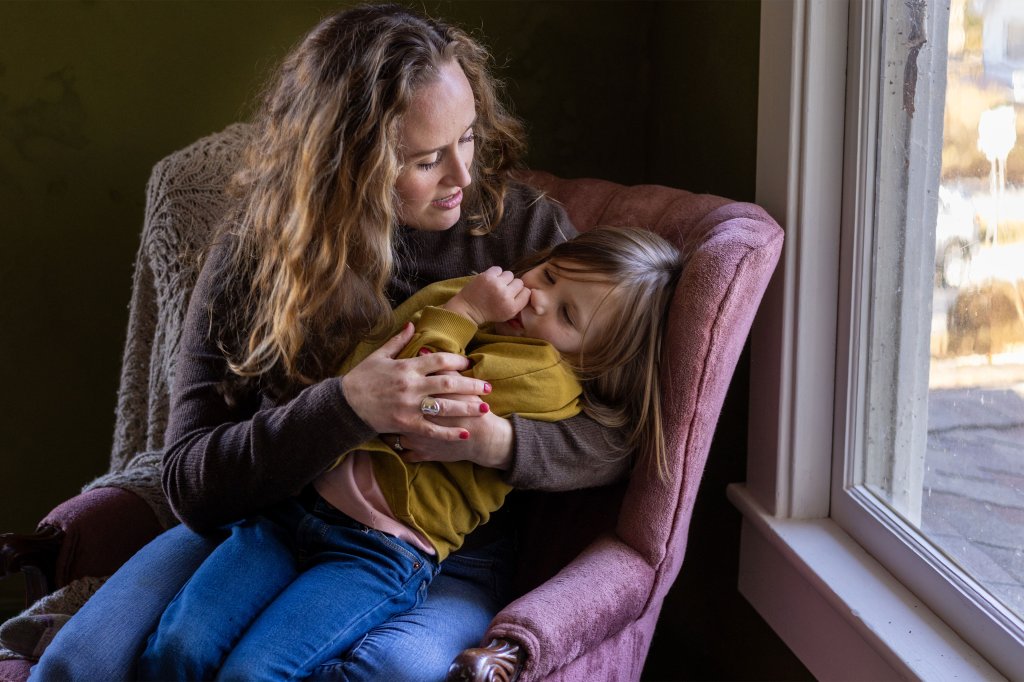
Before giving birth to her second child, Heidi DiLorenzo was anxious. She worried about her blood pressure, and the preeclampsia that prompted her to be hospitalized twice during the pregnancy. She worried that some terrible, unnamed harm would come to her 3-year-old daughter. She worried about her ability to love another baby as much as she loved her first.
But DiLorenzo, an attorney in Birmingham, Alabama, did not worry about taking Zoloft. She had used the medication to treat anxiety before she had her first child, and she continued it throughout that pregnancy and this latest one.
And since having her second daughter, in September, she credits an increased dosage with pulling her out of the “dark hole” of sadness she felt postpartum. “I wouldn’t be as good of a mom to my girls if I didn’t take it,” DiLorenzo said. “I wouldn’t have the energy.”
She is among the estimated 20% of women in the U.S. who have depression or anxiety during or after pregnancy. Yet only half of those mothers receive adequate treatment, according to Kay Roussos-Ross, who runs the perinatal mood disorders program at the University of Florida. And just 5% take a selective serotonin reuptake inhibitor, a class of medications commonly used to treat both conditions.
Now medical experts are concerned that a July panel discussion convened by the Food and Drug Administration could lead to more cases of untreated depression. Many of the 10 members of the panel expressed concern about the use of SSRIs, such as Zoloft, during pregnancy. They included Josef Witt-Doerring, a psychiatrist who owns clinics aimed at helping people wean themselves off antidepressants, and Adam Urato, an OB-GYN who recently petitioned the FDA to put stronger warnings on SSRIs.
While the discussion did not represent any official FDA guidance, the panelists — in claims the American College of Obstetricians and Gynecologists called “outlandish and unfounded” — linked the drugs to increased risks of miscarriage, birth defects, and autism in children exposed to them in utero. The Society for Maternal-Fetal Medicine said its members were “alarmed by the unsubstantiated and inaccurate claims made by FDA panelists.”
Antidepressants are a safe, “lifesaving” tool, given that mental health issues such as suicide and overdoses are the leading cause of maternal death in the country, ACOG President Steven Fleischman said in a statement on the group’s website.
Christena Raines, a nurse practitioner who in 2011 helped found the nation’s first inpatient perinatal psychiatric unit, in North Carolina, said SSRIs are “probably the most well-studied medicine in pregnancy.” In long-term studies of children exposed to the drugs in utero, she said, researchers haven’t seen problems.
It’s too soon to know whether the panel discussion has affected prescribing rates — or whether those who are pregnant are avoiding the drugs more. But Raines, who teaches at the University of North Carolina-Chapel Hill School of Medicine, said she’s already fielding questions from patients. She said the misinformation the panelists spread — along with President Donald Trump’s distorted claims about taking Tylenol during pregnancy — is making her job harder.
Dorothy DeGuzman is a family medicine physician who treats high-risk pregnancies in California. “There’s already so much stigma around taking antidepressants in pregnancy,” she said. “This will just add to the fear.”
The Panel
The July panel discussion was one of four the FDA has convened since May. In the past, the agency vetted members of advisory committees to avoid conflicts of interest. Yet these panels were chosen in private and the events were held with scant public notice. In a July investigative report by MedPage Today, researchers and consultants raised questions about the events’ ethics and legality.
Department of Health and Human Services spokesperson Emily Hilliard did not directly answer when asked about the panelist selection process. She called the panel events “roundtable discussions” in which experts review the latest scientific evidence, evaluate potential health risks, and “explore safer alternatives.”
The July panel appeared to be following an executive order Trump issued in February establishing the Make America Healthy Again Commission and directing it to “assess the prevalence of and threat posed by the prescription of selective serotonin reuptake inhibitors” and other medications.
Health and Human Services Secretary Robert F. Kennedy Jr., who oversees the FDA, is a frequent critic of such drugs. He has claimed, without evidence, that they might be contributing to school shootings.
In opening remarks at the July panel discussion, FDA Commissioner Marty Makary also voiced concerns about the medications. “From a national standpoint, the more antidepressants we prescribe, the more depression there is,” he said.
‘Not a Luxury’
The sole member of the panel who was both a board-certified psychiatrist and an OB-GYN — the University of Florida’s Roussos-Ross — raised a different concern. “Research shows that in women who stop their medications in pregnancy, they are five times more likely to experience a relapse,” she said.
Mothers with moderate to severe depression and anxiety during pregnancy are more likely to give birth early and have low-birth-weight infants, she added. If they don’t receive treatment, she said, they are more likely to misuse drugs or alcohol and are at risk of suicide. They can have trouble bonding with their babies, Roussos-Ross said, and those children are at higher risk for problems such as attention-deficit/hyperactivity disorder, depression, or anxiety — due to their mother’s mental health challenges, not the SSRIs.
“I want to stress that treating mental illness in pregnancy is not a luxury,” she told the panel. “It’s a necessity.”
Overall, about 19% of U.S. women in their 20s and 30s experience depression, according to the latest data from the Centers for Disease Control and Prevention, and roughly 10% take SSRIs. But studies show that half of women decide to stop taking antidepressants before or during their pregnancies.
One reason so few expectant mothers receive depression treatment, doctors say, is that they are already afraid to take any medications during pregnancy. The majority of DeGuzman’s patients rely on Medicaid, the government health coverage for those with low incomes or disabilities. Half are Latina. She often prescribes SSRIs, she said, but her patients rarely take them.
The issue is especially urgent for Black and Latina mothers, who experience higher rates of depression and anxiety than white, non-Latina mothers but are less likely to receive adequate treatment. Many factors contribute to this disparity, including systemic racism, exposure to violence, misdiagnosis, and a lack of access to care.
Shanna Williams, a perinatal mental health therapist who treats African American mothers in Philadelphia, said many of her clients were already more likely to trust friends and family over their doctors when it comes to whether antidepressants are safe to take while pregnant or breastfeeding. The FDA panel is “one other voice that’s saying you shouldn’t do this,” Williams said. “And that does not help.”
Judite Blanc, who studies perinatal mental health in women of color, said universal child care and paid parental leave would help. “My research showed that the most important thing we can offer is social support,” said Blanc, an assistant professor of psychiatry at the University of Miami Miller School of Medicine. “We need the village to step up.”
Kellyn Haight experienced debilitating depression after she moved to the mountain town of Brevard, North Carolina. The former labor and delivery nurse had no child care for her then-2-year-old daughter and no family or friends nearby as her husband was traveling for work.
Her doctor prescribed Prozac — it didn’t help. She called her husband to return home, but her insomnia just got worse. One morning, she begged him to end her suffering. He took her to the emergency room, and staffers sent her to the psychiatric unit of a local hospital. She said she was stripped of her clothing and put in a locked room. “I felt like a creature, like an animal,” said Haight, now 37. “One of my biggest fears is that happening again.”
After she was released, Haight found a psychiatrist and started taking Zoloft. She built a community of friends and began to feel stable.
Now that her daughter is 5, she’s trying to have another child — and plans to keep taking Zoloft throughout the pregnancy. “I would rather be safe and present for my child,” she said. “I’m OK with assuming the risk, because I know what the alternative looks like, and I’m not going there.”
KFF Health News is a national newsroom that produces in-depth journalism about health issues and is one of the core operating programs at KFF—an independent source of health policy research, polling, and journalism. Learn more about KFF.
USE OUR CONTENT
This story can be republished for free (details).