



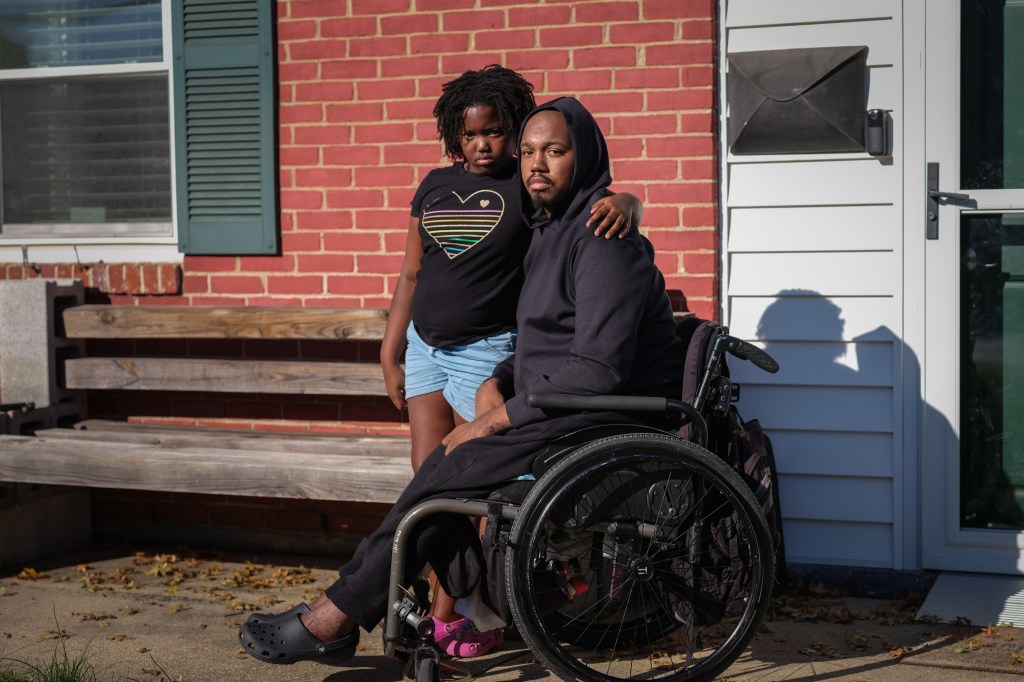
PHILADELPHIA — Leon Harris, 35, is intimately familiar with the devastation guns can inflict. Robbers shot him in the back nearly two decades ago, leaving him paralyzed from the chest down. The bullet remains lodged in his spine.
“When you get shot,” he said, “you stop thinking about the future.”
He is anchored by his wife and child and faith. He once wanted to work as a forklift driver but has built a stable career in information technology. He finds camaraderie with other gunshot survivors and in advocacy.
Still, trauma remains lodged in his daily life. As gun violence surged in the shadows of the covid pandemic, it shook Harris’ fragile sense of security. He moved his family out of Philadelphia to a leafy suburb in Delaware. But a nagging fear of crime persists.
Now he is thinking about buying a gun.
Harris is one of tens of thousands of Americans killed or injured each year by gun violence, a public health crisis that escalated in the pandemic and churns a new victim into a hospital emergency room every half hour.
Over the past two decades, the firearm industry has ramped up production and stepped up sales campaigns through social media influencers, conference presentations, and promotions. An industry trade group acknowledged that its traditional customer was “pale, male and stale” and in recent years began targeting Black people and other communities of color who are disproportionately victimized by gun violence.
The Trump administration has moved to reduce federal oversight of gun businesses, heralding a new era announced by the Bureau of Alcohol, Tobacco, Firearms and Explosives as “marked by transparency, accountability, and partnership with the firearms industry.”
The pain of gun violence crosses political, cultural, and geographic divides — but no group has suffered as much as Black people, such as Harris. They were nearly 14 times as likely to die by gun homicide than white people in 2021, researchers said, citing federal data. Black men and boys are 6% of the population but more than half of homicide victims.
Washington has offered little relief: Guns remain one of few consumer products the federal government does not regulate for health and safety.
“The politics of guns in the U.S. are so out of whack with proper priorities that should focus on health and safety and most fundamental rights to live,” said attorney Jon Lowy, founder of Global Action on Gun Violence, who helped represent Mexico in an unsuccessful lawsuit against Smith & Wesson and other gunmakers that reached the Supreme Court. “The U.S. allows and enables gun industry practices that would be totally unacceptable anywhere else in the world.”
KFF Health News undertook an examination of gun violence during the pandemic, a period when firearm deaths reached an all-time high. Reporters reviewed academic research, congressional reports, and hospital data and interviewed dozens of gun violence and public health experts, gun owners, and victims or their relatives.
The examination found that while public officials imposed restrictions intended to prevent covid’s spread, politicians and regulators helped fuel gun sales — and another public health crisis.
As state and local governments shut down schools, advised residents to stay home, and closed gyms, theaters, malls, and other businesses to stop covid’s spread, President Donald Trump kept gun stores open, deeming them essential businesses critical to the functioning of society.
White House spokesperson Kush Desai did not respond to interview requests or answer questions about the Trump administration’s efforts to reduce regulation of the firearm industry.
During the pandemic, the federal government gave firearm businesses and groups more than $150 million in financial assistance through the Paycheck Protection Program, even as some businesses reported brisk sales, according to an analysis from Everytown for Gun Safety, an advocacy group.
Federal officials said the program would keep people employed, but millions of dollars went to firearm companies that did not say whether it would save any jobs, the report said.
About 1 in 5 American households bought a gun during the first two years of the pandemic, including millions of first-time buyers, according to survey data from NORC at the University of Chicago.
Harris is keenly aware of what drives the demand.
“Guns aren’t going away unless we get to the root of people’s fears,” he said.
Surveys show most Americans who own a gun feel it makes them safer. But public health data suggests that owning a gun doubles the risk of homicide and triples chances of suicide in a home.
“There’s no evidence that guns provide an increase in protection,” said Kelly Drane, research director for the Giffords Law Center to Prevent Gun Violence. “We have been told a fundamental lie.”
Record Deaths
Less than a year into the pandemic, 20-year-old Jacquez Anlage was shot dead in a Jacksonville, Florida, apartment. Five years later, the killing remains unsolved.
His mother, Crystal Anlage, said she fell to her knees and wailed in grief on her lawn when police delivered the news.
She said Jacquez overcame years in the foster care system — living in 36 homes — before she and her husband, Matt, adopted him at age 16.
Jacquez Anlage had just moved into his own apartment when he was shot. He loved animals and wanted to become a veterinary technician. He was kind and loving, Crystal Anlage said, with the 6-foot-4, 215-pound physique of the football and basketball player he’d been.
“He was just getting to a point in life where he felt safe,” Crystal Anlage said.
Gun violence researchers say parents like Crystal Anlage carry trauma that destroys their sense of security.
Anlage said she endures post-traumatic stress disorder and anxiety. She is terrified of guns and fireworks.
But she has made something meaningful of her son’s killing: She co-founded the Jacksonville Survivors Foundation, which works to raise awareness about the impact of homicide and to support grieving parents.
“Jacquez’s death can’t be in vain,” she said. “I want his legacy to be love.”
His legacy and that of other young men killed by guns is muted by firearm manufacturers’ powerful message of fear.
During the pandemic, gun marketers told Americans they needed firearms to defend themselves against criminals, protesters, unreliable cops, and racial and political unrest, according to a petition filed by gun control advocacy groups with the Federal Trade Commission.
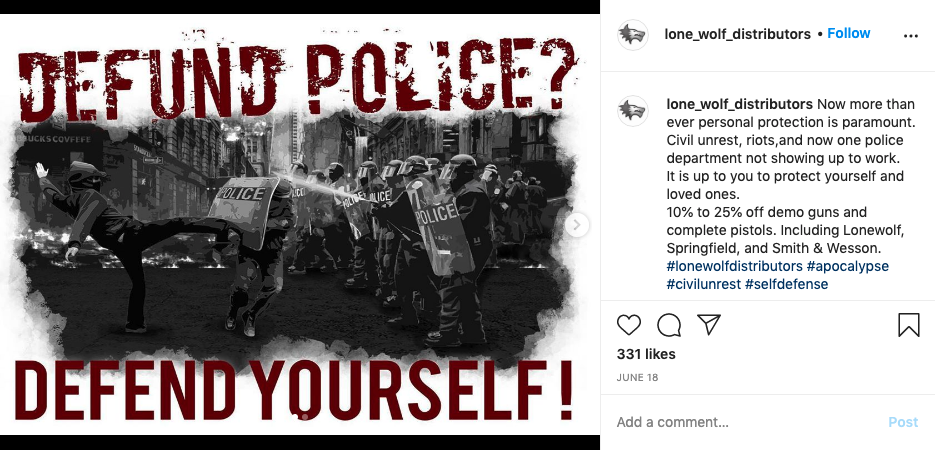
In a since-deleted June 18, 2020, Instagram post from Lone Wolf Arms, an Idaho-based manufacturer, a protester is depicted being confronted by police officers in riot gear between the words “Defund Police? Defend Yourself,” the petition shows. The caption says, “10% to 25% off demo guns and complete pistols.”
Impact Arms, an online gun seller, posted a picture on Instagram on Aug. 3, 2020, showing a person putting a rifle in a backpack, the document says. “The world is pretty crazy right now,” the caption reads. “Not a bad idea to pack something more efficient than a handgun.”
The National Rifle Association in 2020 posted on YouTube a four-minute video of a Black woman holding a rifle and telling viewers they need a gun in the pandemic. “You might be stockpiling up on food right now to get through this current crisis,” she said, “but if you aren’t preparing to defend your property when everything goes wrong, you’re really just stockpiling for somebody else.”
The messaging worked. Background checks for firearm sales soared 60% from 2019 to 2020, the year the federal government declared a public health emergency.
The same year, more than 45,000 Americans died from firearm violence, the highest number up till then. In 2021, the record was broken again.
Weapons sold at the beginning of the pandemic were more likely to wind up at crime scenes within a year than in any previous period, according to a report by Democrats on Congress’ Joint Economic Committee, citing ATF data.
Gun manufacturers “used disturbing sales tactics” following mass shootings in Buffalo, New York, and Uvalde, Texas, “while failing to take even basic steps to monitor the violence and destruction their products have unleashed,” according to a separate memo released by congressional Democrats in July 2022 following a House Oversight and Reform Committee investigation of industry practices and profits.
The firearm industry has marketed “to white supremacist and extremist organizations for years, playing on fears of government repression against gun owners and fomenting racial tensions,” the House investigation said. “The increase in racially motivated violence has also led to rising rates of gun ownership among Black Americans, allowing the industry to profit from both white supremacists and their targets.”
In 2024, then-President Joe Biden’s Department of the Interior provided a $215,000 grant to the National Shooting Sports Foundation, a leading firearm industry trade group, to help companies market guns to Black Americans.
The Federal Trade Commission is responsible for protecting consumers from deceptive and unfair business practices and has the power to take enforcement action. It issued warnings to companies that made unsubstantiated claims their products could prevent or treat covid, for instance.
But when families of gun violence victims, lawmakers, and advocacy groups asked the FTC in 2022, during Biden’s term, to investigate how firearms were marketed to children, people of color, and groups that espouse white supremacy, officials did not announce any public action.
This summer, the National Shooting Sports Foundation pressed its case to the FTC and derided “a coordinated ‘lawfare’ campaign” that it said gun control groups have waged against “constitutionally-protected firearm advertising.”
FTC spokesperson Mitchell Katz declined to comment, saying in an email that the agency does not acknowledge or deny the existence of investigations.
Serena Viswanathan, who retired as an FTC associate director in June, told KFF Health News that the agency lost at least a quarter of the staff in its advertising practices division after Trump came into office in January.
Gun companies Smith & Wesson, Lone Wolf Arms, and Impact Arms did not respond to requests for comment. Neither did the National Shooting Sports Foundation or the NRA.
In an August 2022 social media post, Smith & Wesson President and CEO Mark Smith said gun manufacturers were being wrongly blamed by some politicians for the pandemic surge in violence, saying cities experiencing violent crime had “promoted irresponsible, soft-on-crime policies that often treat criminals as victims and victims as criminals.”
He added, “Some now seek to prohibit firearm manufacturers and supporters of the 2nd Amendment from advertising products in a manner designed to remind law-abiding citizens that they have a Constitutional right to bear arms in defense of themselves and their families.”
Guns and Race
In 2015, the National Shooting Sports Foundation gathered supporters at a conference in Savannah, Georgia, and urged the firearm industry to diversify its customer base, according to a YouTube video and reports from Everytown for Gun Safety and the Violence Policy Center.
Competitive shooter Chris Cheng gave a presentation called “Diversity: The Next Big Opportunity.” Screenshots from the conference include slides purporting to show “demographics,” “psychographics,” and “technographics” of Black and Hispanic shooters.
The slides described Black shooters as “expressive and confident socially, in a crowd” and “less likely to be married and to be a college grad.” They said Hispanic shooters were “much more trusting of advertising and celebrities.”
Nick Suplina, senior vice president for law and policy at Everytown for Gun Safety, said industry marketing shifted in the latter half of the 20th century as the popularity of hunting declined. The new sales pitch: guns for personal safety.
“They said, ‘We need to break into new markets,’” Suplina said. “They identified women and people of color. They didn’t have a lot of success until the pandemic, the Black Lives Matter movement, and the death of George Floyd. The marketing says, ‘You deserve the Second Amendment too.’ They are selling the product as an antidote to fear and anxiety.”
Gun manufacturers were harshly criticized in the Oversight Committee’s 2022 investigation for marketing products to people of color, as gun violence remains a leading cause of death for young Black and Latino men.
At the same time, some companies also promoted assault rifles to white supremacist groups who believe a race war is imminent, the investigation found. One company sold an AK-47-style rifle called the “Big Igloo Aloha,” a reference to an anti-government movement, it said.
Still, Philip Smith wants more Black people to get guns for protection.
Smith said he was working as a human resources consultant a decade ago when he got the idea to form the National African American Gun Association, which helped the National Shooting Sports Foundation compile its report on communicating with Black consumers.
Smith encourages Black people to buy firearms for self-defense and get proper training on how to use them.
After 10 years, Smith said, his group has about 45,000 members nationwide. Single members pay $39 a year and couples $59, which gives them access to discounts from the organization’s corporate partners, including gunmakers, and raffles for gun giveaways, according to its website.
The police killing of Michael Brown in Ferguson, Missouri, and the shooting death of Florida teenager Trayvon Martin helped spark early interest from doctors, lawyers, and others in joining the group, he said. But interest took off during the pandemic, he said, even among Democrats who had resisted the idea of owning a gun.
“Hundreds of people called me and said, ‘I don’t agree with anything you’re saying, but what kind of gun should I buy,’” Smith recalled.
Smith, describing himself as “quiet, nerdy, and Afrocentric,” said criticism of guns misses the point.
“My ancestors bled for us to have this right,” he said. “Are there some racist white people? Yes. But we should buy guns because there is a need. No one is forcing us to buy guns.”
‘American Amnesia’
During the pandemic, gun violence took its greatest toll on racially segregated neighborhoods in places such as Philadelphia, where roughly 1 in 4 residents live in poverty.
A city report says a one-year period in the pandemic saw more than 2,300 shootings, or about six a day. Many of the cases haven’t been solved by police.
City officials cited the boom in gun sales in the report: Fewer than 400,000 sales took place in Pennsylvania in 2000, but in 2020 it was more than 1 million.
Gun sales have dropped since the pandemic ended, but the harm they’ve caused persists.
At a conference last year inside the Eagles’ football stadium, victims of firearm violence or their relatives joined activists to share accounts of near-death experiences and the grief of losing loved ones.
Paintings flanked the stage and the meeting space to commemorate people who had been fatally shot, nearly all young people of color, under messages such as “You are loved and missed forever” and “Those we love never leave.”
Marion Wilson, a community activist, said he believes the nation has forgotten the suffering Philadelphia and other cities endured during the pandemic.
“We suffer from the disease of American amnesia,” he said.
Harris was on his way home from a job at Burlington Coat Factory nearly two decades ago when robbers followed him from a bus stop and demanded money. He said he had none and was shot.
Harris had spent his early life fixing cars with his grandfather, when he wasn’t at school or attending church. He remembers lying in a hospital bed, overcome with a sense of helplessness.
“I had to learn to feed myself again,” he said. “I was like a baby. I had to learn to sit up so I could use a wheelchair. The only way I got through it was my faith in God.”
Harris endured years of rehabilitation and counseling for PTSD. As someone in a wheelchair, he said, he sometimes fears for his safety — and a gun may be one of the few ways to protect himself and his family.
“I’m mulling it over,” Harris said. “I’m afraid of my trauma hurting someone else. That’s the only reason I haven’t gotten one yet.”
If you or someone you know has experienced the pain of a gunshot wound, and are willing to talk about the medical experience, please fill out our form here.
KFF Health News is a national newsroom that produces in-depth journalism about health issues and is one of the core operating programs at KFF—an independent source of health policy research, polling, and journalism. Learn more about KFF.
USE OUR CONTENT
This story can be republished for free (details).