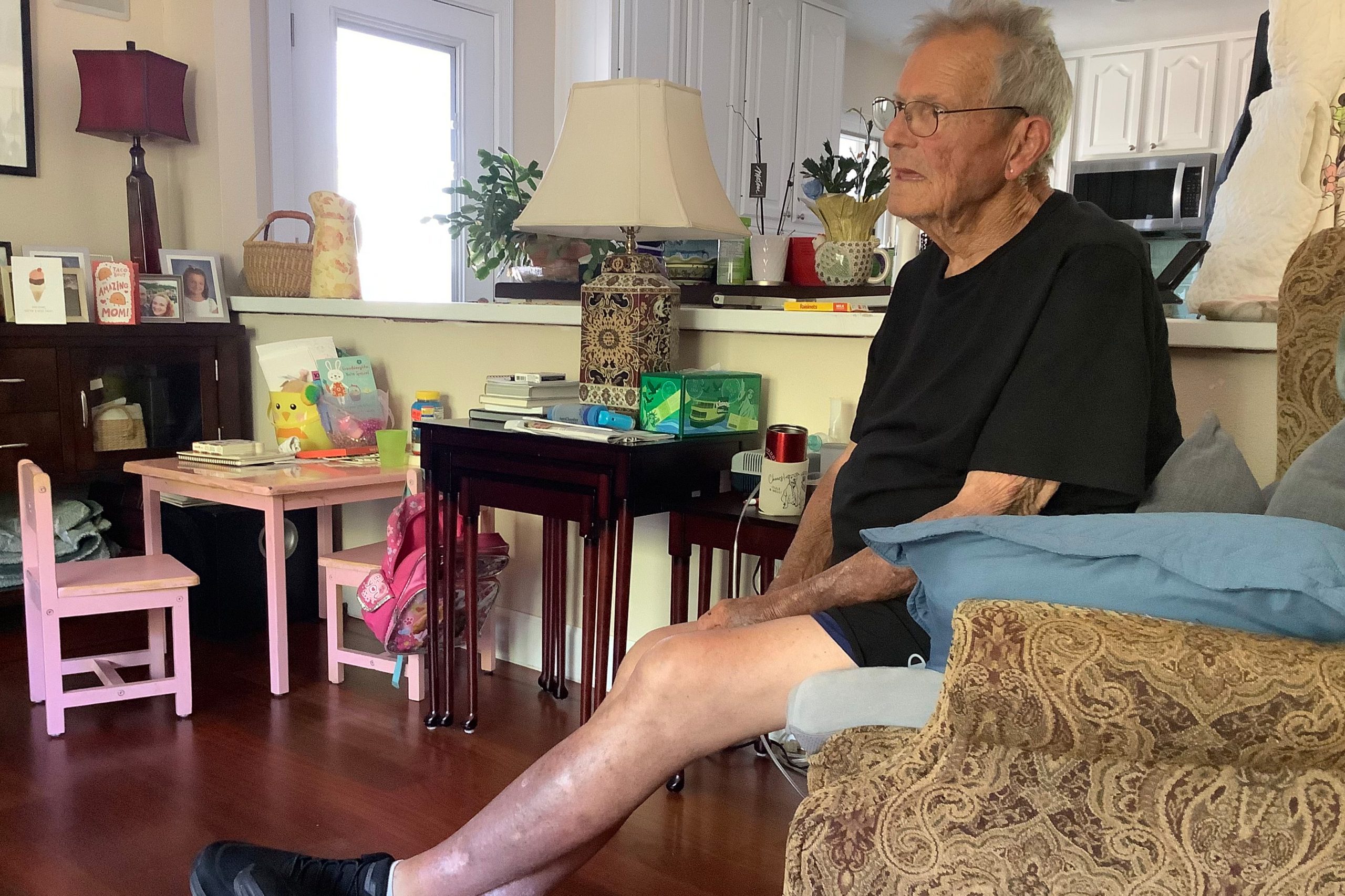
Mark Vantrease regularly sees his Vietnam War buddies over breakfast, attends his grandchildren’s Little League games, and, when he’s up to it, tends to his lush front-yard garden, which is dotted with shells retrieved from his abalone-diving days.
Time is precious for him. Last year, doctors told the 76-year-old former truck driver that a combination of heart failure, lung disease, and liver damage had left him with only six months to live. “That was about 11 months ago,” Vantrease said in a May interview, smiling at having, for the moment, cheated death.
In June 2025, Vantrease began hospice, which focuses on quality of life for terminally ill patients, receiving regular visits from a nurse in his home in Novato, California. Medicare is covering those services for him. His hospice caregivers reminded him of the attention his unit received from medical staff in Vietnam.
“We used to call them guardian angels,” he said, “because they took such great care of you.”
But the Trump administration’s allegations of unchecked hospice fraud in California have tainted the industry’s reputation, prompting concerns that fewer patients will seek the care they need. Health policy researchers and hospice administrators worry that the negative attention on the industry and potential for overly punitive regulations could put California patients and taxpayers on the losing end.
“The fraud situation has done a lot of damage to the reputation of hospices overall and undone a lot of the progress that had been made in destigmatizing hospice,” said Lauren Hunt, an associate professor at the University of California-San Francisco’s Philip R. Lee Institute for Health Policy Studies who focuses on hospice care. “Policymakers should pursue targeted strategies that root out fraud and abuse without overburdening the many providers who are doing the right thing.”
Hospice care is facing sweeping restrictions. The Centers for Medicare & Medicaid Services in May announced a six-month national moratorium on hospice provider enrollment in Medicare and increased oversight in California and several other states with “elevated fraud risk”: Arizona, Georgia, Nevada, Ohio, and Texas.
In a statement, CMS spokesperson Timothy Foster said state inaction on hospice programs rife with fraud drove the need for federal intervention. Foster said CMS believes the crackdown won’t affect patients’ ability to obtain services, with roughly 7,000 hospices still approved nationwide, and that it will help ensure the hospices that remain provide the care “individuals near end of life deserve.”
“Ensuring patient safety and access to quality hospices and other certified healthcare services is paramount to CMS’ work,” Foster said.
Mehmet Oz, the CMS administrator, has said the strict approach also protects taxpayer money. Studies have concluded that even as for-profit hospices have expanded, the industry has saved Medicare money by offsetting other expensive care. A 2023 University of Chicago report commissioned by industry associations estimated that Medicare patients who used hospice over hospitals in 2019 saved taxpayers over $3 billion.
California has already been cracking down on the problems, with Democratic Attorney General Rob Bonta deeming hospice fraud an “epidemic” last year and asserting that the state is “on it.” The state has had its own moratorium on hospice licenses since 2021, charged numerous providers with crimes over the years, and implemented emergency regulations to curb fraud this June.
Hunt said she’s heard from California healthcare providers who are reluctant to refer patients to hospice because they’re unsure the patients will receive high-quality care and from patients who don’t know which hospice providers they can trust. California has the most hospice organizations of any state — approximately 2,800 as of 2022, according to the California state auditor’s office. That same year, CMS reported 5,800 hospice agencies nationwide.
Hospice administrators in good standing have already found themselves in the crosshairs: A Washington Post investigation in June found that the federal government’s new anti-fraud task force has already suspended licenses for 43 legitimate hospices.
Still, Hunt and other policy researchers welcome the efforts to target unscrupulous operators.
“While most hospices are committed to providing high-quality care, there are serious concerns about a subset that exploit patients and the system for financial gain,” she said.
The hospice industry is uniquely vulnerable to fraud because of insufficient licensing regulations and inadequate oversight, according to industry researchers. And the percentage of the population aging into Medicare is rapidly rising, with spending expected to accelerate in the next 10 years.
Most of the rapid growth in operators has been among for-profit hospices, a state auditor’s report in 2022 noted. In California, about 94% of hospice providers are now for-profit, a shift from 20 years ago, when nonprofits dominated the industry in California and nationally. On average, for-profit operators make around $2,100 more per patient in pretax profit and $49 more per patient-day than nonprofit hospice operators, according to one study.
Skelly Wingard, CEO of By the Bay Health, a Northern California nonprofit that provides services to Vantrease, acknowledges that fraud is a big problem in the industry. “These organizations that have exploited patients were extremely savvy,” she said.
But Wingard warns against losing sight of the bigger picture.
“Hospice, when done well, is one of the most compassionate and meaningful benefits in healthcare,” she said. “We should be working to protect that, not inadvertently erode confidence in it.”
By the Bay Health has been in business for 50 years and serves around 750 hospice patients in the Bay Area. About 89% of them are covered by Medicare, 3% by California’s Medicaid program, Medi-Cal, and the rest by commercial health plans, Wingard said.
At home in Novato, Vantrease lifts his shirt to show where a catheter was surgically implanted to drain uncomfortable fluid buildup in his abdomen. The hospital trained his wife, Paula Vantrease, a retired career counselor, to connect a suctioning device to the catheter to siphon the excess fluid. A hospice nurse from By the Bay, Blake Knier, helped her master the technique the first few times she tried it at home.
“Paula is the rock in my foundation,” Mark Vantrease said.
Knier orders all of Vantrease’s medications and rejiggers them when necessary to manage his bouts of intense nausea and pain. Every week, Knier checks the surgical incision around the catheter for infection, listens to Vantrease’s lungs, checks his blood pressure, and cleans and dresses the open wounds that sometimes form from burst blisters on his legs, a complication of the fluid buildup and weakened skin.
Hospice nurse Blake Knier listens to Mark Vantrease’s lungs. (Laurie Udesky for KFF Health News)
Knier helps usher hospice patients and their families through critical turning points. He recalled guiding one patient’s daughter through her mother’s loss of appetite.
“It’s OK if your mother isn’t eating vegetables,” he told the patient’s daughter. “Let her eat ice cream, if that’s what she wants.”
California’s emergency regulations against fraud took effect in late June. In addition to tighter prescreening of license applicants, they call for minimum professional qualifications for management, higher nurse-to-patient ratios, stricter rules around physical office space, and other restrictions.
Hunt said the new regulations are a step in the right direction but urged caution.
“The broader impact on the industry should be closely monitored, particularly to ensure that well-intentioned, high-quality providers are not placed under undue strain or forced to close,” she said.
Late one night last year, when Knier wasn’t available, another hospice nurse from By the Bay Health came promptly to the Vantreases’ home in response to an urgent call from Paula.
“I felt like I was about to die,” Mark Vantrease said, explaining he’d just had a premonition that he wouldn’t wake up in the morning. His sons were called to his bedside. The family needed reassurance. So a nurse arrived, examined him, and checked their father’s vitals.
By midnight, he was sleeping.
Mark and Paula Vantrease in their home in Novato, California. (Laurie Udesky for KFF Health News)
KFF Health News is a national newsroom that produces in-depth journalism about health issues and is one of the core operating programs at KFF—an independent source of health policy research, polling, and journalism. Learn more about KFF.
This article first appeared on KFF Health News and is republished here under a Creative Commons Attribution-NonCommercial-NoDerivatives 4.0 International License.