




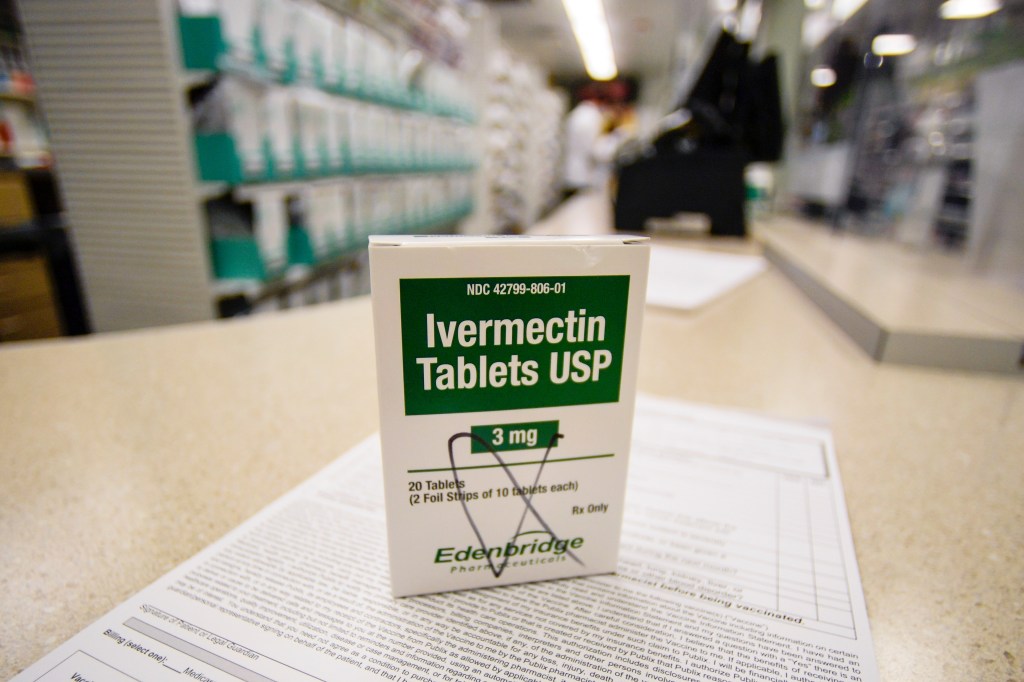
The National Cancer Institute, the federal research agency charged with leading the war against the nation’s second-largest killer, is studying ivermectin as a potential cancer treatment, according to its top official.
“There are enough reports of it, enough interest in it, that we actually did — ivermectin, in particular — did engage in sort of a better preclinical study of its properties and its ability to kill cancer cells,” said Anthony Letai, a physician the Trump administration appointed as NCI director in September.
Letai did not cite new evidence that might have prompted the institute to research the effectiveness of the antiparasitic drug against cancer. The drug, largely used to treat people or animals for infections caused by parasites, is a popular dewormer for horses.
“We’ll probably have those results in a few months,” Letai said. “So we are taking it seriously.”
He spoke about ivermectin at a Jan. 30 event, “Reclaiming Science: The People’s NIH,” with National Institutes of Health Director Jay Bhattacharya and other senior agency officials at Washington, D.C.’s Willard Hotel. The MAHA Institute hosted the discussion, framed by the “Make America Healthy Again” agenda of Health and Human Services Secretary Robert F. Kennedy Jr. The National Cancer Institute is the largest of the NIH’s 27 branches.
During the covid pandemic, ivermectin’s popularity surged as fringe medical groups promoted it as an effective treatment. Clinical trials have found it isn’t effective against covid.
Ivermectin has become a symbol of resistance against the medical establishment among MAHA adherents and conservatives. Like-minded commentators and wellness and other online influencers have hyped — without evidence — ivermectin as a miracle cure for a host of diseases, including cancer. Trump officials have pointed to research on ivermectin as an example of the administration’s receptiveness to ideas the scientific establishment has rejected.
“If lots of people believe it and it’s moving public health, we as NIH have an obligation, again, to treat it seriously,” Bhattacharya said at the event. According to The Chronicle at Duke University, Bhattacharya recently said he wants the NIH to be “the research arm of MAHA.”
The decision by the world’s premier cancer research institute to study ivermectin as a cancer treatment has alarmed career scientists at the agency.
“I am shocked and appalled,” one NCI scientist said. “We are moving funds away from so much promising research in order to do a preclinical study based on nonscientific ideas. It’s absurd.”
KFF Health News granted the scientist and other NCI workers anonymity because they are not authorized to speak to the press and fear retaliation.
HHS and the National Cancer Institute did not answer KFF Health News’ questions on the amount of money the cancer institute is spending on the study, who is carrying it out, and whether there was new evidence that prompted NCI to look into ivermectin as an anticancer therapy. Emily Hilliard, an HHS spokesperson, said NIH is dedicated to “rigorous, gold-standard research,” something the administration has repeatedly professed.
A preclinical study is an early phase of research conducted in a lab to test whether a drug or treatment may be useful and to assess potential harms. These studies take place before human clinical trials.
The scientist questioned whether there is enough initial evidence to warrant NCI’s spending of taxpayer funds to investigate the drug’s potential as a cancer treatment.
The FDA has approved ivermectin for certain uses in humans and animals. Tablets are used to treat conditions caused by parasitic worms, and the FDA has approved ivermectin lotions to treat lice and rosacea. Two scientists involved in its discovery won the Nobel Prize in 2015, tied to the drug’s success in treating certain parasitic diseases.
The FDA has warned that large doses of ivermectin can be dangerous. Overdoses can cause seizures, comas, or death.
Kennedy, supporters of the MAHA movement, and some conservative commentators have promoted the idea that the government and pharmaceutical companies quashed ivermectin and other inexpensive, off-patent drugs because they’re not profitable for the drug industry.
“FDA’s war on public health is about to end,” Kennedy wrote in an October 2024 X post that has since gone viral. “This includes its aggressive suppression of psychedelics, peptides, stem cells, raw milk, hyperbaric therapies, chelating compounds, ivermectin, hydroxychloroquine, vitamins, clean foods, sunshine, exercise, nutraceuticals and anything else that advances human health and can’t be patented by Pharma.”
Previous laboratory research has shown that ivermectin could have anticancer effects because it promotes cell death and inhibits the growth of tumor cells. “It actually has been studied both with NIH funds and outside of NIH funds,” Letai said.
However, there is no evidence that ivermectin is safe and effective in treating cancer in humans. Preliminary data from a small clinical trial that gave ivermectin to patients with one type of metastatic breast cancer, in combination with immunotherapy, found no significant benefit from the addition of ivermectin.
Some physicians are concerned that patients will delay or forgo effective cancer treatments, or be harmed in other ways, if they believe unfounded claims that ivermectin can treat their disease.
“Many, many, many things work in a test tube. Quite a few things work in a mouse or a monkey. It still doesn’t mean it’s going to work in people,” said Jeffery Edenfield, executive medical director of oncology for the South Carolina-based Prisma Health Cancer Institute.
Edenfield said cancer patients ask him about ivermectin “regularly,” mostly because of what they see on social media. He said he persuaded a patient to stop using it, and a colleague recently had a patient who decided “to forgo highly effective standard therapy in favor of ivermectin.”
“People come to the discussion having largely already made up their mind,” Edenfield said.
“We’re in this delicate time when there’s sort of a fundamental mistrust of medicine,” he added. “Some people are just not going to believe me. I just have to keep trying.”
A June letter by clinicians at Cincinnati Children’s Hospital Medical Center in Ohio detailed how an adolescent patient with metastatic bone cancer started taking ivermectin “after encountering social media posts touting its benefits.” The patient — who hadn’t been given a prescription by a clinician — experienced ivermectin-related neurotoxicity and had to seek emergency care because of nausea, fatigue, and other symptoms.
“We urge the pediatric oncology community to advocate for sensible health policy that prioritizes the well-being of our patients,” the clinicians wrote.
The lack of evidence about ivermectin and cancer hasn’t stopped celebrities and online influencers from promoting the notion that the drug is a cure-all. On a January 2025 episode of Joe Rogan’s podcast, actor Mel Gibson claimed that a combination of drugs that included ivermectin cured three friends with stage 4 cancer. The episode has been viewed more than 12 million times.
Lawmakers in a handful of states have made the drug available over the counter. And Florida — which, under Republican Gov. Ron DeSantis, has become a hotbed for anti-vaccine policies and the spread of public health misinformation — announced last fall that the state plans to fund research to study the drug as a potential cancer treatment.
The Florida Department of Health did not respond to questions about that effort.
Letai, previously a Dana-Farber Cancer Institute oncologist, started at the National Cancer Institute after months of upheaval caused by Trump administration policies.
“What you’re hearing at the NIH now is an openness to ideas — even ideas that scientists would say, ‘Oh, there’s no way it could work’ — but nevertheless applying rigorous scientific methods to those ideas,” Bhattacharya said at the Jan. 30 event.
A second NCI scientist, who was granted anonymity due to fear of retaliation, said the notion that NIH was not open to investigating the value of off-label drugs in cancer is “ridiculous.”
“This is not a new idea they came up with,” the scientist said.
Letai didn’t elaborate on whether NCI scientists are conducting the research or if it has directed funding to an outside institution. Three-quarters of the cancer institute’s research dollars go to outside scientists.
He also aimed to temper expectations.
“At least on a population level,” Letai said, “it’s not going to be a cure-all for cancer.”
KFF Health News is a national newsroom that produces in-depth journalism about health issues and is one of the core operating programs at KFF—an independent source of health policy research, polling, and journalism. Learn more about KFF.
USE OUR CONTENT
This story can be republished for free (details).